

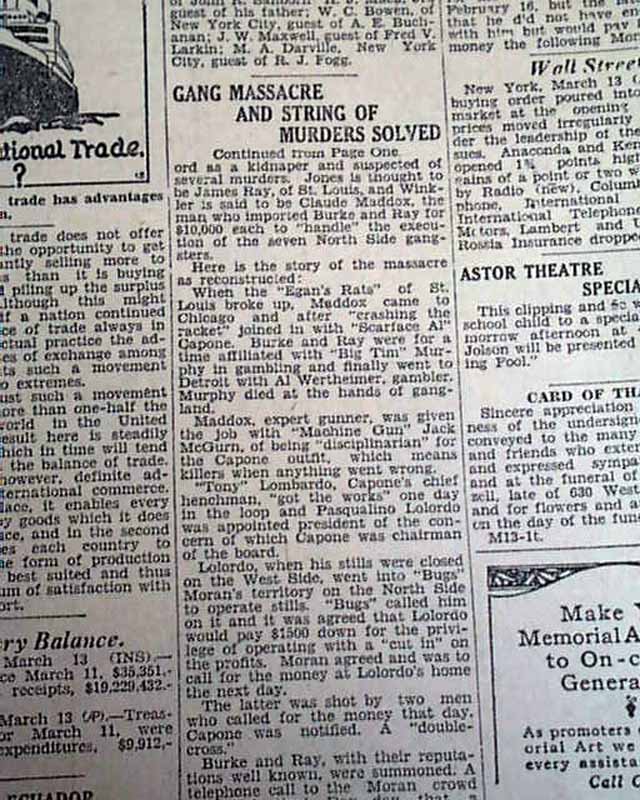
Al Capone linked to massacre....
Item # 564149Sorry, but this item is no longer available. Please be in touch at info@rarenewspapers.com if you would like to be placed on a want list or are interested in a potential alternate issue.
March 13, 1929
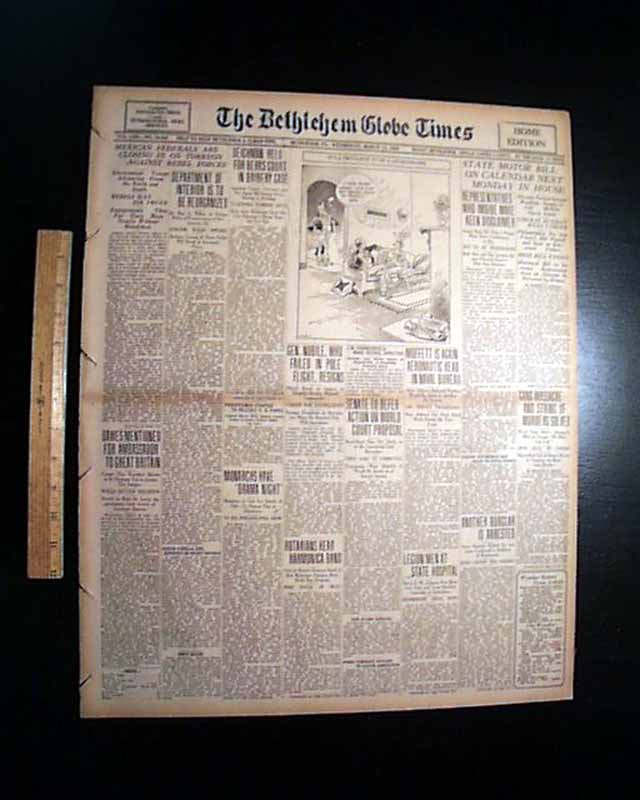
THE BETHLEHEM GLOBE TIMES, from Bethlehem, Pennsylvania, dated March 13, 1929
* Post St. Valentine's Day Massacre
* Al Capone considered responsible (1st report)
This 24 page newspaper has one column headlines on the front page:
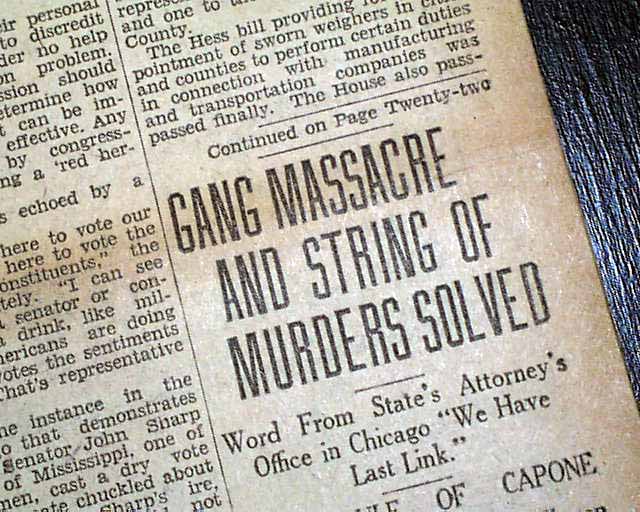
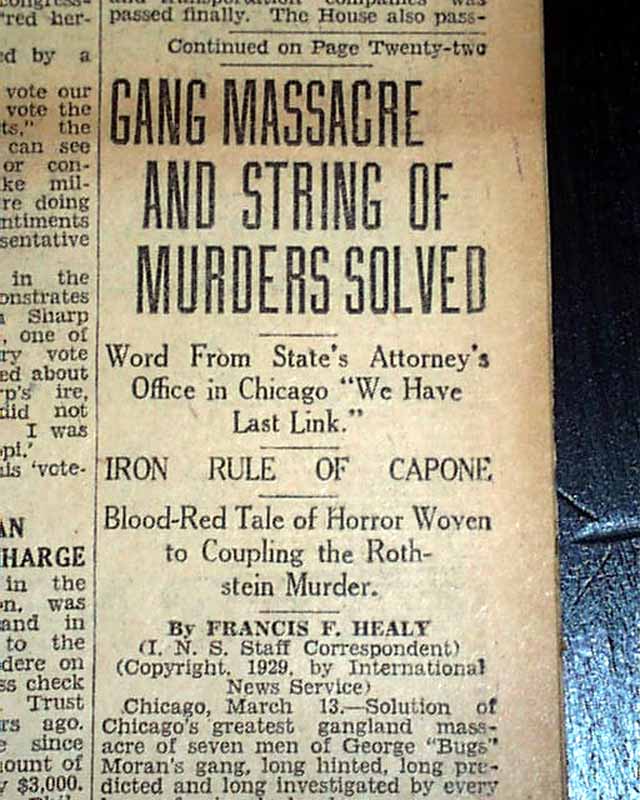
* GANG MASSACRE AND STRING OF MURDERS SOLVED
* Word From State's Attorney's Office in Chicago 'We Have Last Link'
* IRON RULE OF CAPONE
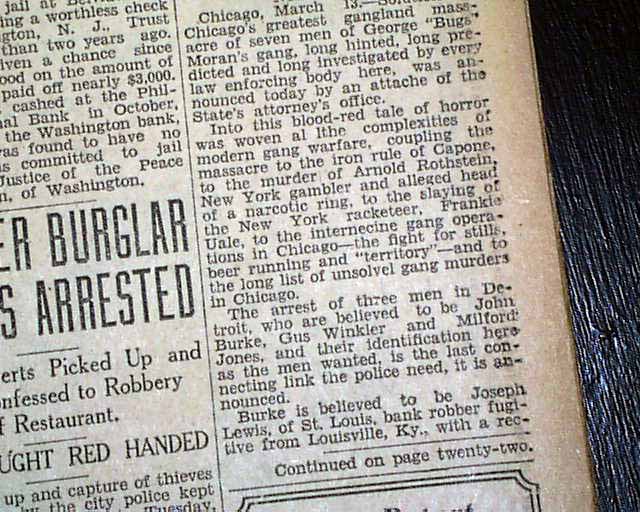
and more. Tells of the investigation in which Al Capone was thought to be the mastermind behind it all but could not be proved with concrete evidence.
Other news of the day. Light browning with minor margin wear, otherwise good.
wikipedia notes: The Saint Valentine's Day massacre is the name given to the murder of seven people as part of a Prohibition Era conflict between two powerful criminal gangs in Chicago, Illinois, in 1929: the South Side Italian gang led by Al Capone and the North Side Irish gang led by Bugs Moran. Former members of the Egan's Rats gang were also suspected to have played a large role in the St. Valentine's Day massacre, assisting Capone.
The slaughter exceeded anything yet seen in the United States at that time. At first, it was thought that police might indeed have been responsible for the killings, but 255 detectives were soon cleared. Chicago Police scrambled to figure out who had been responsible.
Since it was common knowledge that Moran was hijacking Capone's Detroit-based liquor shipments, police focused their attention on the Purple Gang. Mug shots of Purple members George Lewis, Eddie Fletcher, Phil Keywell and his younger brother Harry, were picked out by the landlady across the street as the phony roomers. Later, the women who identified them wavered, and, Fletcher, Lewis, and Harry Keywell were all questioned and cleared by Chicago Police. Nevertheless, the Keywell brothers (and by extension the Purple Gang) would remain ensnared in the massacre case for all time.
A week after the massacre, a 1927 Cadillac sedan was found disassembled and partially burned in a garage on Wood Street. It was determined that the car had been used by the massacre killers. The garage was located two blocks from the Circus Café, which was operated by Claude Maddox, a former St. Louis gangster and member of the Capone mob.
Detectives checking leads in St. Louis discovered that former members of the Egan's Rats mob might have played a part. They soon announced they were seeking Fred "Killer" Burke and James Ray as the two uniformed police officers in the garage. Burke and other members of the mob had been known to use police uniforms to fool their victims. Police also proposed that Joseph Lolordo may have been one of the machine gunners, mostly likely because his brother Pasqualino had recently been murdered by the North Side Gang.
Police also announced they suspected Capone gunmen John Scalise and Albert Anselmi, as well as Jack McGurn himself, and Frank Rio, a Capone bodyguard. Police eventually charged McGurn and Scalise with the massacre. John Scalise was murdered before he went to trial and the charges against Jack McGurn were downgraded to a violation of the Mann Act, stemming from taking the main witness against him, girlfriend Louise Rolfe (who became known as the "Blonde Alibi"), across state lines to marry.
The case stagnated until December 14, 1929, when Berrien County sheriffs raided the St. Joseph, Michigan bungalow of “Frederick Dane”. Dane had been the registered owner of a vehicle driven by Fred "Killer" Burke. Burke had been drinking and rear-ended another vehicle in front of the police station. Officer Charles Skelly ran outside to investigate. When Burke attempted to drive away, Officer Skelly hopped on the running board and was shot off. He died of his wounds a short time later.
When police raided Burke's bungalow, they found a bulletproof vest, bonds recently stolen from a Wisconsin bank, two Thompson submachine guns, pistols, two shotguns, and thousands of rounds of ammunition. Both machine guns were determined to have been used in the massacre. Unfortunately, no further concrete evidence would surface in the massacre case. Burke would be captured over a year later on a Missouri farm. As the case against him in the murder of Officer Skelly was strongest, he was tried in Michigan and subsequently sentenced to life imprisonment. Fred Burke died in prison in 1940.
* Post St. Valentine's Day Massacre
* Al Capone considered responsible (1st report)
This 24 page newspaper has one column headlines on the front page:
* GANG MASSACRE AND STRING OF MURDERS SOLVED
* Word From State's Attorney's Office in Chicago 'We Have Last Link'
* IRON RULE OF CAPONE
and more. Tells of the investigation in which Al Capone was thought to be the mastermind behind it all but could not be proved with concrete evidence.
Other news of the day. Light browning with minor margin wear, otherwise good.
wikipedia notes: The Saint Valentine's Day massacre is the name given to the murder of seven people as part of a Prohibition Era conflict between two powerful criminal gangs in Chicago, Illinois, in 1929: the South Side Italian gang led by Al Capone and the North Side Irish gang led by Bugs Moran. Former members of the Egan's Rats gang were also suspected to have played a large role in the St. Valentine's Day massacre, assisting Capone.
The slaughter exceeded anything yet seen in the United States at that time. At first, it was thought that police might indeed have been responsible for the killings, but 255 detectives were soon cleared. Chicago Police scrambled to figure out who had been responsible.
Since it was common knowledge that Moran was hijacking Capone's Detroit-based liquor shipments, police focused their attention on the Purple Gang. Mug shots of Purple members George Lewis, Eddie Fletcher, Phil Keywell and his younger brother Harry, were picked out by the landlady across the street as the phony roomers. Later, the women who identified them wavered, and, Fletcher, Lewis, and Harry Keywell were all questioned and cleared by Chicago Police. Nevertheless, the Keywell brothers (and by extension the Purple Gang) would remain ensnared in the massacre case for all time.
A week after the massacre, a 1927 Cadillac sedan was found disassembled and partially burned in a garage on Wood Street. It was determined that the car had been used by the massacre killers. The garage was located two blocks from the Circus Café, which was operated by Claude Maddox, a former St. Louis gangster and member of the Capone mob.
Detectives checking leads in St. Louis discovered that former members of the Egan's Rats mob might have played a part. They soon announced they were seeking Fred "Killer" Burke and James Ray as the two uniformed police officers in the garage. Burke and other members of the mob had been known to use police uniforms to fool their victims. Police also proposed that Joseph Lolordo may have been one of the machine gunners, mostly likely because his brother Pasqualino had recently been murdered by the North Side Gang.
Police also announced they suspected Capone gunmen John Scalise and Albert Anselmi, as well as Jack McGurn himself, and Frank Rio, a Capone bodyguard. Police eventually charged McGurn and Scalise with the massacre. John Scalise was murdered before he went to trial and the charges against Jack McGurn were downgraded to a violation of the Mann Act, stemming from taking the main witness against him, girlfriend Louise Rolfe (who became known as the "Blonde Alibi"), across state lines to marry.
The case stagnated until December 14, 1929, when Berrien County sheriffs raided the St. Joseph, Michigan bungalow of “Frederick Dane”. Dane had been the registered owner of a vehicle driven by Fred "Killer" Burke. Burke had been drinking and rear-ended another vehicle in front of the police station. Officer Charles Skelly ran outside to investigate. When Burke attempted to drive away, Officer Skelly hopped on the running board and was shot off. He died of his wounds a short time later.
When police raided Burke's bungalow, they found a bulletproof vest, bonds recently stolen from a Wisconsin bank, two Thompson submachine guns, pistols, two shotguns, and thousands of rounds of ammunition. Both machine guns were determined to have been used in the massacre. Unfortunately, no further concrete evidence would surface in the massacre case. Burke would be captured over a year later on a Missouri farm. As the case against him in the murder of Officer Skelly was strongest, he was tried in Michigan and subsequently sentenced to life imprisonment. Fred Burke died in prison in 1940.
Category: The 20th Century


