

First airplane fatality...
Item # 567021Sorry, but this item is no longer available. Please be in touch at info@rarenewspapers.com if you would like to be placed on a want list or are interested in a potential alternate issue.
September 18, 1908
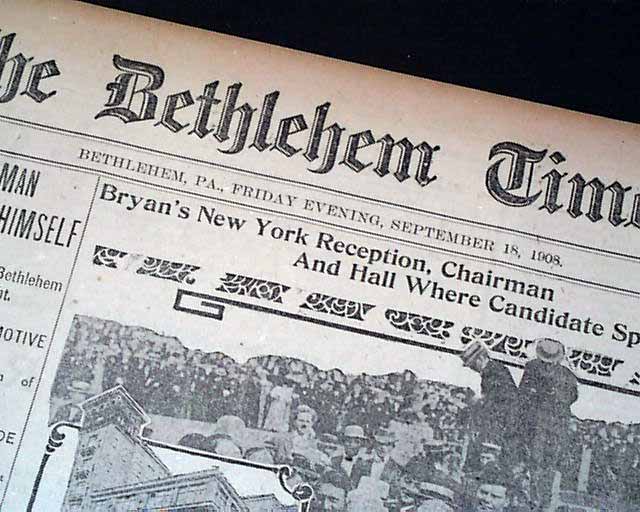
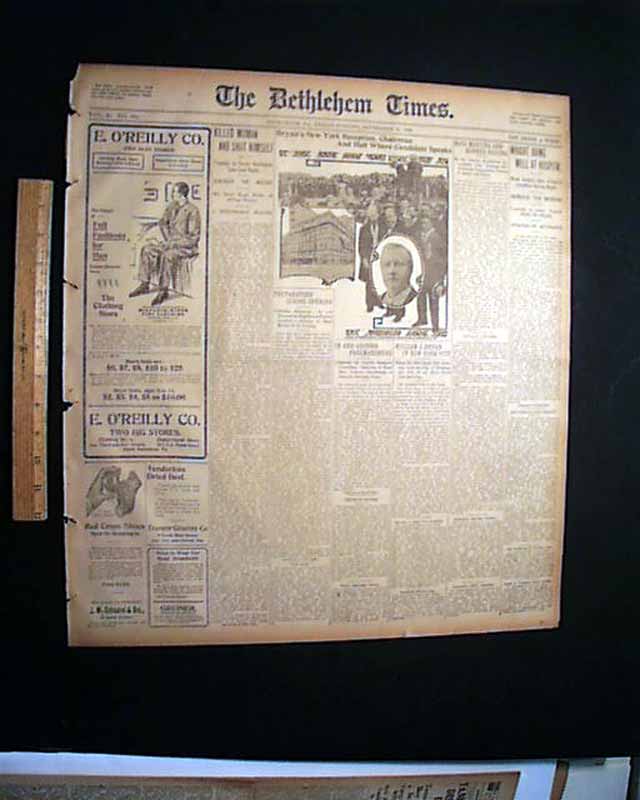
THE BETHLEHEM TIMES, Pennsylvania, September 18, 1908
* Orville Wright Injured
* Thomas Etholen Selfridge Killed
* 1st powered airplane fatality
This 10 page newspaper has one column headlines on the front page that include:
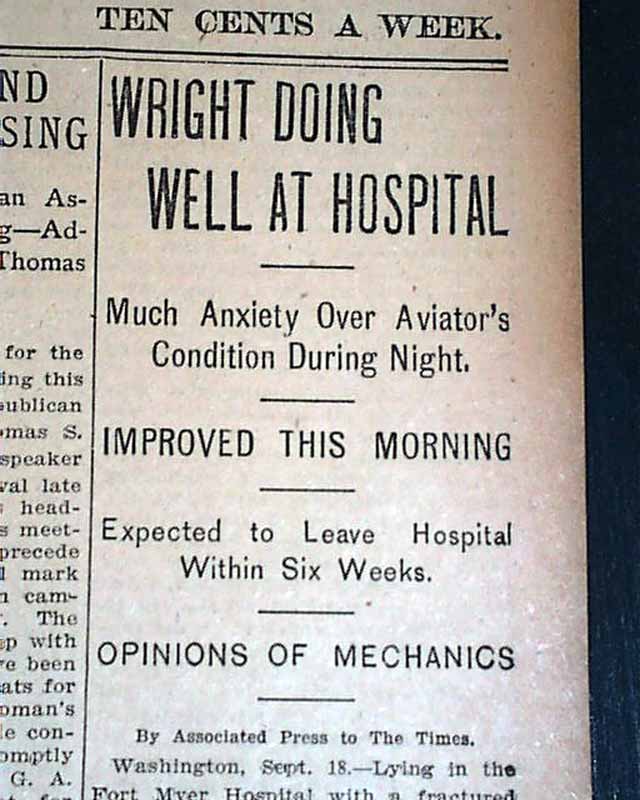
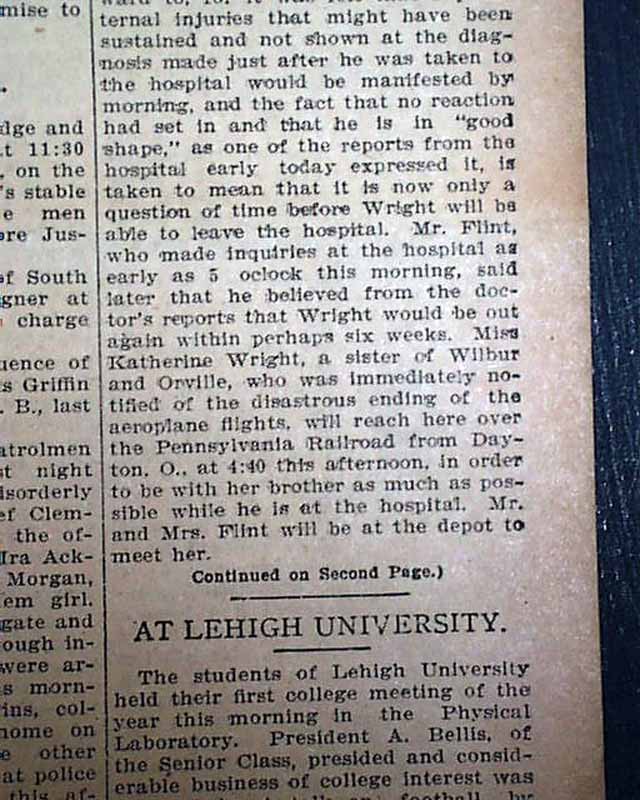
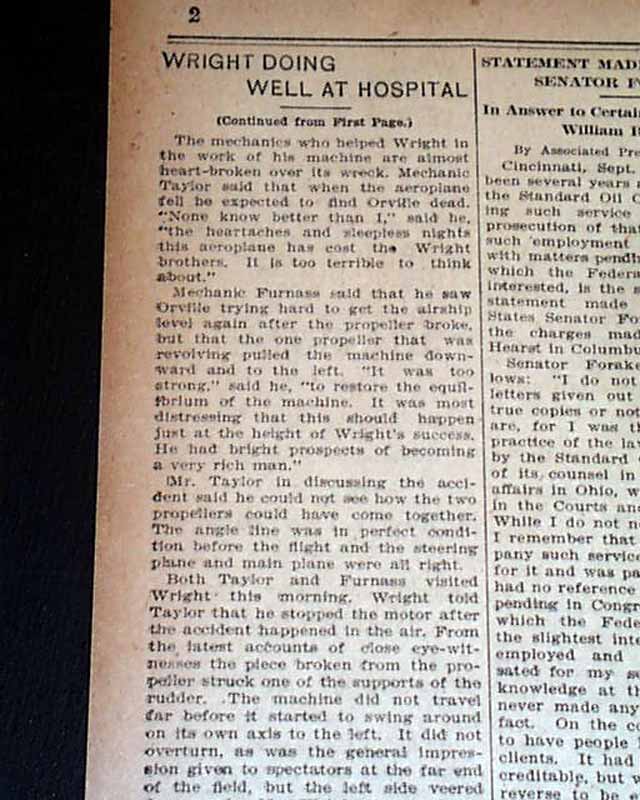
* WRIGHT DOING WELL AT HOSPITAL
* Much Anxiety Over Aviator's Condition During Night
* Expected to Leave Hospital Within Six Weeks
and more. (see)
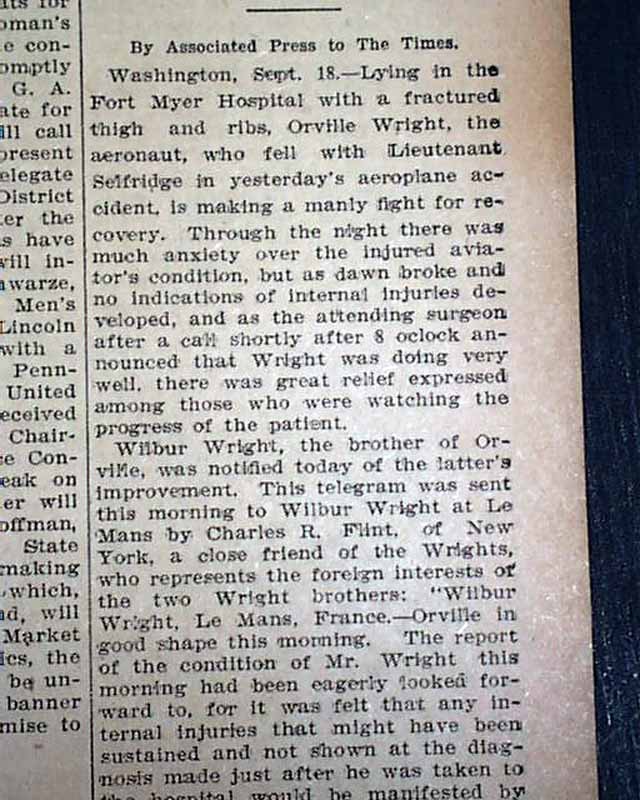
Nice, lengthy article (continues on page 2) on the flight by Wright and Selfridge in which the first human fatality occurred by a powered airplane.
Other news of the day. This issue has usual browning with little margin wear, otherwise good. Should be handled with care.
wikipedia notes: Thomas Etholen Selfridge (February 8, 1882 – September 17, 1908) was a First Lieutenant in the U.S. Army and the first person to die in a crash of a powered airplane.
When Orville Wright came to Fort Myer to demonstrate the Wright Flyer for the US Army Signal Corps division, Selfridge arranged to be a passenger while Orville piloted the craft. On September 17, 1908, the Wright Flyer circled Fort Myer 4½ times at 150 feet (46 m). Halfway through the fifth circuit, the right propeller broke, losing thrust. This set up a vibration, causing the split propeller to hit a guy wire bracing the rear vertical rudder. The wire tore out of its fastening and shattered the propeller; the rudder swiveled to the horizontal and sent the Flyer into a nose-dive. Orville shut off the engine and managed to glide to about 75 feet (23 m), but the Flyer hit the ground nose first.[2]
Orville later described the accident that killed Selfridge in a letter to his brother, Wilbur:
On the fourth round, everything seemingly working much better and smoother than any former flight, I started on a larger circuit with less abrupt turns. It was on the very first slow turn that the trouble began. ... A hurried glance behind revealed nothing wrong, but I decided to shut off the power and descend as soon as the machine could be faced in a direction where a landing could be made. This decision was hardly reached, in fact I suppose it was not over two or three seconds from the time the first taps were heard, until two big thumps, which gave the machine a terrible shaking, showed that something had broken. ... The machine suddenly turned to the right and I immediately shut off the power. Quick as a flash, the machine turned down in front and started straight for the ground. Our course for 50 feet (15 m) was within a very few degrees of the perpendicular. Lt. Selfridge up to this time had not uttered a word, though he took a hasty glance behind when the propeller broke and turned once or twice to look into my face, evidently to see what I thought of the situation. But when the machine turned head first for the ground, he exclaimed 'Oh! Oh!' in an almost inaudible voice.
When the craft hit the ground, both Selfridge and Wright were thrown against the remaining wires. Selfridge was thrown against one of the wooden uprights of the framework, and his skull was fractured. He underwent neurosurgery but died that evening without regaining consciousness. He was 26. Orville suffered severe injuries, including a broken left thigh, several broken ribs and a damaged hip, and was hospitalized for seven weeks. Selfridge was not wearing any headgear, while Wright was only wearing a cap, as two existing photographs taken before the flight prove. If Selfridge had been wearing a helmet of some sort, he most likely would have survived the crash. As a result of Selfridge's death, the US Army's first pilots wore large heavy headgear reminiscent of early football helmets.
* Orville Wright Injured
* Thomas Etholen Selfridge Killed
* 1st powered airplane fatality
This 10 page newspaper has one column headlines on the front page that include:
* WRIGHT DOING WELL AT HOSPITAL
* Much Anxiety Over Aviator's Condition During Night
* Expected to Leave Hospital Within Six Weeks
and more. (see)
Nice, lengthy article (continues on page 2) on the flight by Wright and Selfridge in which the first human fatality occurred by a powered airplane.
Other news of the day. This issue has usual browning with little margin wear, otherwise good. Should be handled with care.
wikipedia notes: Thomas Etholen Selfridge (February 8, 1882 – September 17, 1908) was a First Lieutenant in the U.S. Army and the first person to die in a crash of a powered airplane.
When Orville Wright came to Fort Myer to demonstrate the Wright Flyer for the US Army Signal Corps division, Selfridge arranged to be a passenger while Orville piloted the craft. On September 17, 1908, the Wright Flyer circled Fort Myer 4½ times at 150 feet (46 m). Halfway through the fifth circuit, the right propeller broke, losing thrust. This set up a vibration, causing the split propeller to hit a guy wire bracing the rear vertical rudder. The wire tore out of its fastening and shattered the propeller; the rudder swiveled to the horizontal and sent the Flyer into a nose-dive. Orville shut off the engine and managed to glide to about 75 feet (23 m), but the Flyer hit the ground nose first.[2]
Orville later described the accident that killed Selfridge in a letter to his brother, Wilbur:
On the fourth round, everything seemingly working much better and smoother than any former flight, I started on a larger circuit with less abrupt turns. It was on the very first slow turn that the trouble began. ... A hurried glance behind revealed nothing wrong, but I decided to shut off the power and descend as soon as the machine could be faced in a direction where a landing could be made. This decision was hardly reached, in fact I suppose it was not over two or three seconds from the time the first taps were heard, until two big thumps, which gave the machine a terrible shaking, showed that something had broken. ... The machine suddenly turned to the right and I immediately shut off the power. Quick as a flash, the machine turned down in front and started straight for the ground. Our course for 50 feet (15 m) was within a very few degrees of the perpendicular. Lt. Selfridge up to this time had not uttered a word, though he took a hasty glance behind when the propeller broke and turned once or twice to look into my face, evidently to see what I thought of the situation. But when the machine turned head first for the ground, he exclaimed 'Oh! Oh!' in an almost inaudible voice.
When the craft hit the ground, both Selfridge and Wright were thrown against the remaining wires. Selfridge was thrown against one of the wooden uprights of the framework, and his skull was fractured. He underwent neurosurgery but died that evening without regaining consciousness. He was 26. Orville suffered severe injuries, including a broken left thigh, several broken ribs and a damaged hip, and was hospitalized for seven weeks. Selfridge was not wearing any headgear, while Wright was only wearing a cap, as two existing photographs taken before the flight prove. If Selfridge had been wearing a helmet of some sort, he most likely would have survived the crash. As a result of Selfridge's death, the US Army's first pilots wore large heavy headgear reminiscent of early football helmets.
Category: The 20th Century


